
silver electrolysis refining production line
Complete Silver Electrolysis Refining Production Line
A silver electrolysis machine is the center of a refinery, but it cannot produce consistent market-ready silver bars alone. A complete silver electrolysis refining production line must coordinate feed preparation, electrolyte control, ventilation, silver-powder washing, drying, metal recovery and final casting.

What Equipment Is Needed for Silver Electrolytic Refining?
A practical silver refinery plant normally needs more than the electrolytic cells. The core line includes a silver granulator or anode-casting system, silver electrolysis refining equipment, RO/DI process-water treatment, an electrolyte preparation reactor, electrolyte circulation and cooling, local exhaust and an acid-gas scrubber, silver-powder filtration and washing, controlled drying, residual-silver recovery and a melting or vacuum bar casting machine.
The correct configuration depends on the feed assay, required kilograms per 24 hours, final product and local environmental rules. Buyers should therefore compare a complete silver refinery equipment package, not only the price of one electrolysis tank.

Silver Electrolysis Production Line Process
This workflow follows the material from doré or impure silver to washed cathodic silver and finished silver bars.
Confirm silver content and impurity profile, then select granules, anode plates or another approved feed form.
Prepare and condition the silver-nitrate electrolyte using controlled chemistry and suitable process water.
Impure silver dissolves anodically while refined silver deposits or grows at the cathode.
Monitor silver and impurity concentration, acidity, temperature, circulation, voltage and current.
Separate the cathodic silver from the electrolyte without losing fine particles.
Remove retained acid and soluble salts, verify the endpoint and dry the silver safely before melting.
Treat electrolyte, wash water and solids through a validated recovery and wastewater route.
Melt dry refined silver and cast the required silver grain, ingot or investment-bar format.
Core Silver Electrolysis Refining Equipment
Silver electrolysis capacity options cover 5, 10, 30, 50, 100 and 200 kg per 24 hours, allowing the complete refinery line to be matched to workshop and industrial production.

5–10 kg/24h Compact Silver Refinery
For laboratories, jewelry refiners, smaller recycling workshops and customers starting with controlled lower-volume silver purification.
View the 10 kg silver electrolysis guide →
30 kg/24h Silver Electrolysis Refiner
A dedicated mid-capacity machine with approximately 700 × 800 × 1000 mm internal tank dimensions, 0–6 V output, 0–300 A current and PLC touch-screen automatic control.
Ask about the 30 kg configuration →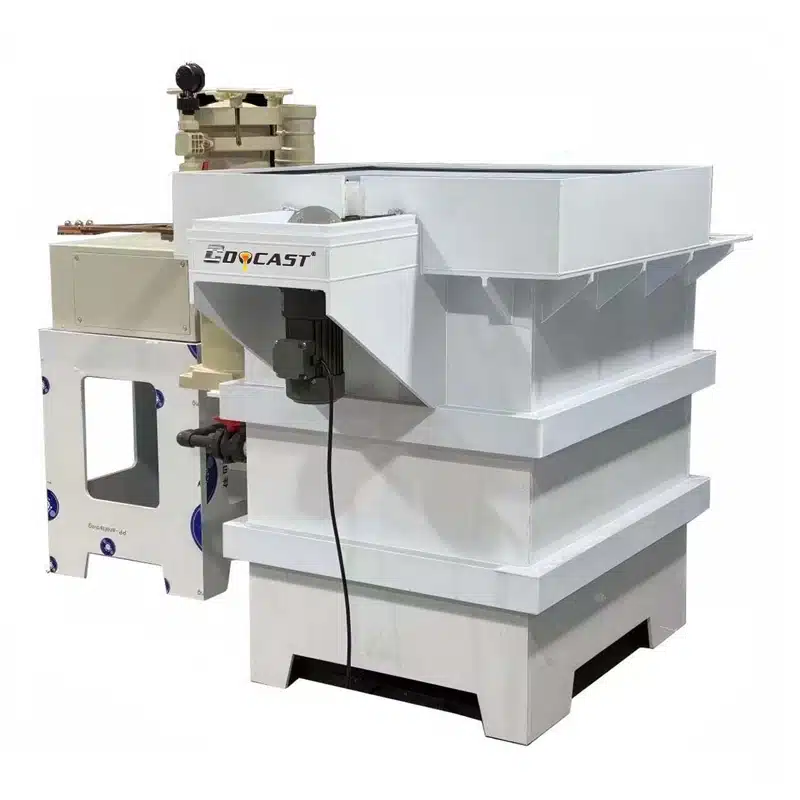
50 kg/24h Industrial Silver Refinery
For steady commercial refining with a matched rectifier, cell, electrolyte circulation, cooling, washing and utility capacity.
View silver refinery equipment →100–200 kg/24h Silver Refining Plant
For high-throughput projects requiring planned tank quantity, current distribution, ventilation, material transfer, silver-powder handling and downstream drying.
Read the industrial refinery guide →Silver Refinery Machine Parameters
The table combines the standard CDO-SE specification sheet with the supplied 30 kg/24h machine data. Values marked “Approx.” are practical planning estimates derived from the 0–6 V, 0–300 A rectifier and the stated tank size; they are not final installation drawings or nameplate data.
| Specification | CDO-SE5 | CDO-SE10 | 30 kg System | CDO-SE50 | CDO-SE100 | CDO-SE200 |
|---|---|---|---|---|---|---|
| Nominal capacity | 5 kg/24h | 10 kg/24h | 30 kg/24h | 50 kg/24h | 100 kg/24h | 200 kg/24h |
| Power | 300 W | 500 W | Approx. 2.5 kW input 1.8 kW maximum DC output | 12 kW | 18 kW | 24 kW |
| Operating voltage | 1–3 V | 1–3 V | 0–6 V | 1–12 V | 1–18 V | 1–18 V |
| Electrolysis current | 0–70 A | 0–100 A | 0–300 A | 0–900 A | 0–1000 A | 0–1000 A |
| Control system | Standard control | Standard control | PLC + touch screen, full automatic | Configured by model | Configured by model | Configured by model |
| Specified input purity | Above 75% | Above 75% | Above 75% | Above 75% | Above 75% | Above 75% |
| Target final purity | ≥99.99% | ≥99.99% | ≥99.99% | ≥99.99% | ≥99.99% | ≥99.99% |
| Plant supply | 220 V, 1 phase | 220 V, 1 phase | Approx. 220 V, 1 phase, 50/60 Hz | 380 V, 3 phase | 380 V, 3 phase | 380 V, 3 phase |
| Internal tank dimensions | Not listed | Not listed | Approx. 700×800×1000 mm | Not listed | Not listed | Not listed |
| Overall dimensions (mm) | 500×310×650 | 643×465×875 | Approx. 1000×1100×1300 | 2100×1800×1600 | 4850×1350×1110 | 5800×1350×1100 |
| Machine weight | 30 kg | 75 kg | Approx. 200 kg | 336 kg | 700 kg | 800 kg |
Upstream Equipment: Silver Granulator and Anode Preparation
Stable electrolysis begins with repeatable feed geometry and a known impurity assay.

Silver Granulator for Electrolysis Feed
A silver granulating machine melts doré or impure silver and forms smaller particles with more exposed surface area. Granules can simplify manual loading when the electrolytic cell is specifically designed with suitable anode baskets and filter bags.
- Select capacity from actual silver throughput, not gold capacity.
- Confirm whether the alloy needs atmosphere protection.
- Control granule size so pieces are retained and electrically connected.
Why Granulated Silver Is Used in This Refining Line
This silver electrolysis refining line uses impure silver granules loaded into a titanium anode basket rather than separately cast anode plates. The granules provide a larger exposed surface area and are easier to load, while the titanium basket maintains electrical contact and the anode bag retains insoluble anode slime.
This arrangement removes the separate anode-plate casting step, but the granules still need to be clean, dry and correctly sized. They must remain inside the basket, maintain electrical contact as they dissolve and allow the silver nitrate electrolyte to circulate freely.

Process Water, Electrolyte Preparation and Cooling
Customers purchasing a complete silver electrolysis refining production line should size these three utility systems together. Water quality, electrolyte temperature and circulation stability directly affect cathode purity, deposit structure and production uptime.
The project document specifies conductivity ≤15 μS/cm for electrolyte preparation and silver-powder washing. When requesting a silver refinery pure water system quotation, provide the feed-water analysis, daily washing demand, storage requirement and operating hours.
A corrosion-resistant, temperature-controlled and agitated reactor can prepare electrolyte by dissolving suitable silver feed in nitric acid. Engineered extraction is required because the reaction can generate hazardous nitrogen oxides.
Pumps, tanks, filters and a correctly sized chiller help stabilize electrolyte temperature and composition. High-current silver electrolysis equipment requires adequate heat removal, uniform flow and control of concentration polarization.
| Silver output | Initial water-system direction | What must still be calculated |
|---|---|---|
| Up to 10 kg/day | Purchased suitable process water may be more economical than a dedicated plant. | Electrolyte make-up, wash cycles, local water quality and storage hygiene. |
| 30–100 kg/day | Evaluate approximately 0.5 t/h RO/DI capacity as a planning reference. | Peak washing demand, recovery rate, feed-water analysis and redundancy. |
| 100–200 kg/day and above | Evaluate an industrial system of 1 t/h or more. | Continuous operation, storage tank, polishing stage, waste ratio and future expansion. |
Ventilation, NOx Collection and Acid-Gas Scrubbing
Fume control is part of the production equipment—not an optional accessory added after commissioning.


Silver Powder Washing, Filtration and Drying
Cathodic silver can retain electrolyte and free acid between particles. Incomplete washing may contribute to discoloration, salt contamination, fumes or poor melting behavior. A repeatable endpoint is therefore more useful than a fixed instruction such as “wash three times.”

Residual Silver Recovery and Wastewater Treatment
Good recovery is measured by solution assays and mass balance, not by a promise of “100% recovery” or “zero waste.”
Keep spent electrolyte, first wash, later wash water, anode slime and floor-cleaning waste separate when their silver and impurity concentrations differ.
Use a validated cementation, precipitation or reduction route selected for the solution chemistry. Agitation can improve contact, but reagent choice determines contamination and downstream handling.
Sample treated liquid and solids for residual silver, metals, nitrate, pH and other locally regulated parameters. Recovery efficiency should be reported from measured input and output.
From Refined Silver Powder to Finished Silver Bars
The last equipment decision depends on whether the customer sells silver powder, makes shot, casts small investment bars or produces large refinery ingots.

Silver Powder or Silver Grain
Customers selling refined silver powder need controlled particle retention, washing, drying, packaging and assay. Customers preparing melting feed may convert the refined silver into manageable grain after drying.

Vacuum Silver Bar Casting Machine for Finished Bullion
A vacuum silver bar making machine converts dry refined silver into bright, dense bullion bars using customized graphite molds and controlled melting and casting. Buyers comparing a vacuum silver bar casting machine for sale should specify the required bar weight, dimensions, hourly output, surface finish, marking method and assay procedure. This allows the supplier to match the furnace, vacuum system, mold, water chiller and downstream marking equipment as one practical silver-bar production solution.
How to Select a Turnkey Silver Refinery Plant
Give the supplier process data before requesting price. A useful quotation must define equipment boundaries, utilities and performance assumptions.
Related Silver Refining Equipment and Guides
These internal pages connect process questions with the corresponding CDOCAST product and technical resources.
Technical References
External sources are provided for safety and finished-bar planning. Project engineering and local regulations remain controlling.
Further reading
- NIOSH health-hazard information on nitrogen dioxide—supports the need for engineered fume control where NOx may be generated.
- LBMA Good Delivery Rules—the current official source for qualifying London Good Delivery silver-bar requirements.
- LBMA technical specifications—covers appearance, dimensions, markings and related acceptance requirements for the applicable bar class.
Silver Electrolysis Refining Equipment FAQ
Purchasing answers for customers comparing a silver refinery machine, supporting equipment and a complete production line.
What is a silver electrolysis refining machine?
A silver electrolysis refining machine uses controlled direct current and a silver-bearing electrolyte to dissolve impure silver at the anode and recover refined silver at the cathode. The system normally includes electrolytic cells, electrodes or baskets, rectifier, circulation, filtration, temperature control and silver collection equipment.
Can silver electrolysis produce 99.99% pure silver?
It can target ≥99.99% silver under suitable feed, electrolyte chemistry and operating control, but purity is not guaranteed by the machine alone. Impurity profile, electrolyte replacement, current density, temperature, washing, cross-contamination and the final assay method all matter.
Which silver refinery machine capacities are available?
CDO-SE capacities include 5, 10, 30, 50, 100 and 200 kg per 24 hours. The 30 kg system uses a 0–6 V, 0–300 A rectifier, an approximately 700×800×1000 mm internal tank and PLC touch-screen automatic control. Its power, plant supply, overall size and weight in the table are clearly identified as planning estimates.
Do I need a silver granulator before electrolysis?
You need a granulator only when the selected cell is designed to accept silver granules in suitable anode baskets or bags. A plate-anode system instead requires melting and anode casting. Confirm the approved feed form with the equipment supplier.
Why does a silver refinery need RO or DI water?
Low-ion process water helps avoid introducing chloride and other unwanted ions into the electrolyte or washed silver. The source document uses ≤15 μS/cm as a project requirement, but the final conductivity and ion specification should be approved for the actual process.
Is neutral pH enough to confirm that silver powder is clean?
No. pH is useful for identifying residual acidity, but neutral wash water can still contain dissolved salts. A validated washing endpoint should also consider conductivity and appropriate residual-ion tests, as well as the final silver assay requirement.
What determines the cost of a complete silver electrolysis production line?
Cost depends on daily capacity, feed assay, cell quantity, rectifier, automation, electrolyte circulation and cooling, RO/DI water, reactor, fume scrubber, washing and drying, recovery and wastewater treatment, laboratory requirements, installation and final silver-bar equipment.
What information is needed for a turnkey silver refinery quotation?
Provide feed composition, kilograms per day, operating hours, target purity, desired final product, country, power, cooling water, floor space, existing ventilation and wastewater facilities, required automation, and whether installation and operator training are needed.
Planning a Complete Silver Refinery Line?
Send CDOCAST your feed assay, target kg/24h, final product and available utilities. Our engineers can match the silver electrolysis machine with the required granulation, water, fume-control, washing, drying, recovery and bar-casting equipment.