
How To Make Gold Foil Banknotes
How to Make Gold Foil Banknotes from Raw Metal
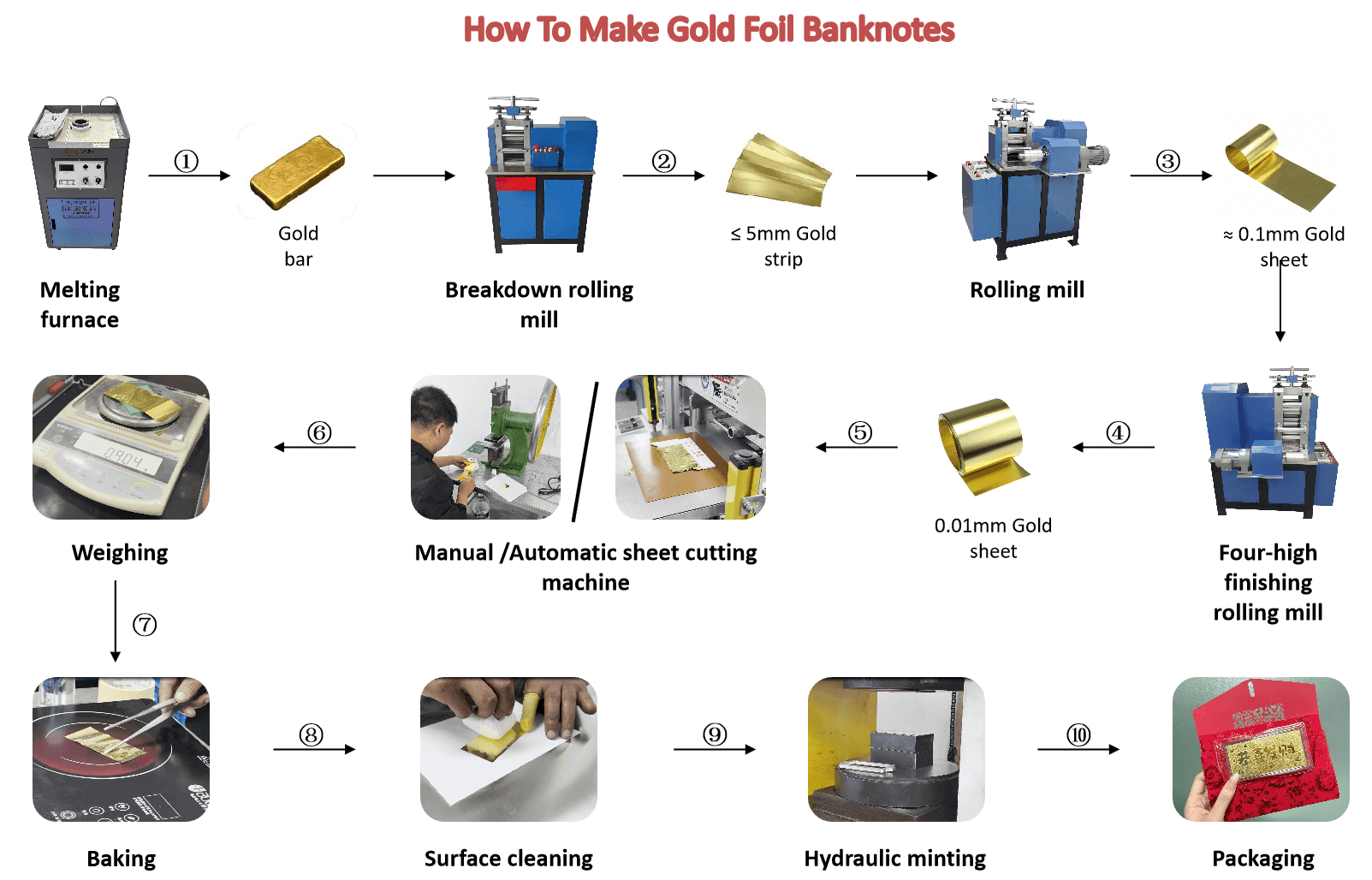
A practical gold foil banknote production line melts or continuously casts high-purity metal, reduces the strip through three rolling stages, cuts and cleans the ultra-thin foil, embosses it with a dedicated hydraulic press die, and protects the finished product by sealing or blister packaging.
The decisive machine is the CNC four-high precision rolling mill. It completes the final reduction from about 0.1 mm to the normal 0.005 mm production target. The specified CDOCAST machine range reaches down to 0.004 mm under suitable material and process conditions.
What Equipment Is Required to Make a Gold Foil Banknote?
A complete line normally needs a melting furnace or a precious-metal continuous casting machine, a breakdown rolling mill, an intermediate rolling mill, a CNC servo-controlled four-high precision rolling mill, a foil cutting machine or small blanking press, a small cleaning oven, a hydraulic press with a dedicated gold banknote die, and suitable packaging equipment.
It is not a one-machine process. The first two rolling mills prepare stable incoming strip; the third four-high mill determines whether the material can reach the required ultra-thin, flat and uniform foil condition without unacceptable wrinkles, tearing or thickness variation.
Eight Operations from Raw Gold to Packaged Gold Banknote
Prepare a clean bar or strip.
Reduce cast feed over 10 mm to about 5 mm.
Prepare uniform 0.1 mm strip.
Finish near 0.005 mm.
Produce the required foil dimensions.
Remove light surface residue before pressing.
Form the design with a dedicated die.
Seal the delicate finished foil promptly.
Detailed Gold Foil Banknote Manufacturing Process

Choose a Melting Furnace or Continuous Casting Machine
For a lower-investment or flexible small-batch line, melt Au 9999, Ag 9999 or the approved alloy in a suitable gold melting furnace and cast a clean plate or bar for rolling. Control inclusions, oxide, shrinkage and mold condition because defects introduced here may remain visible after the material becomes foil.
For higher investment and more consistent strip preparation, use a precious metal continuous casting machine. A matched flat graphite mold and crystallizer can produce denser, more uniform strip with a smoother starting surface, reducing variation entering the rolling process.
Reduce the Thick Bar or Strip to About 5 mm
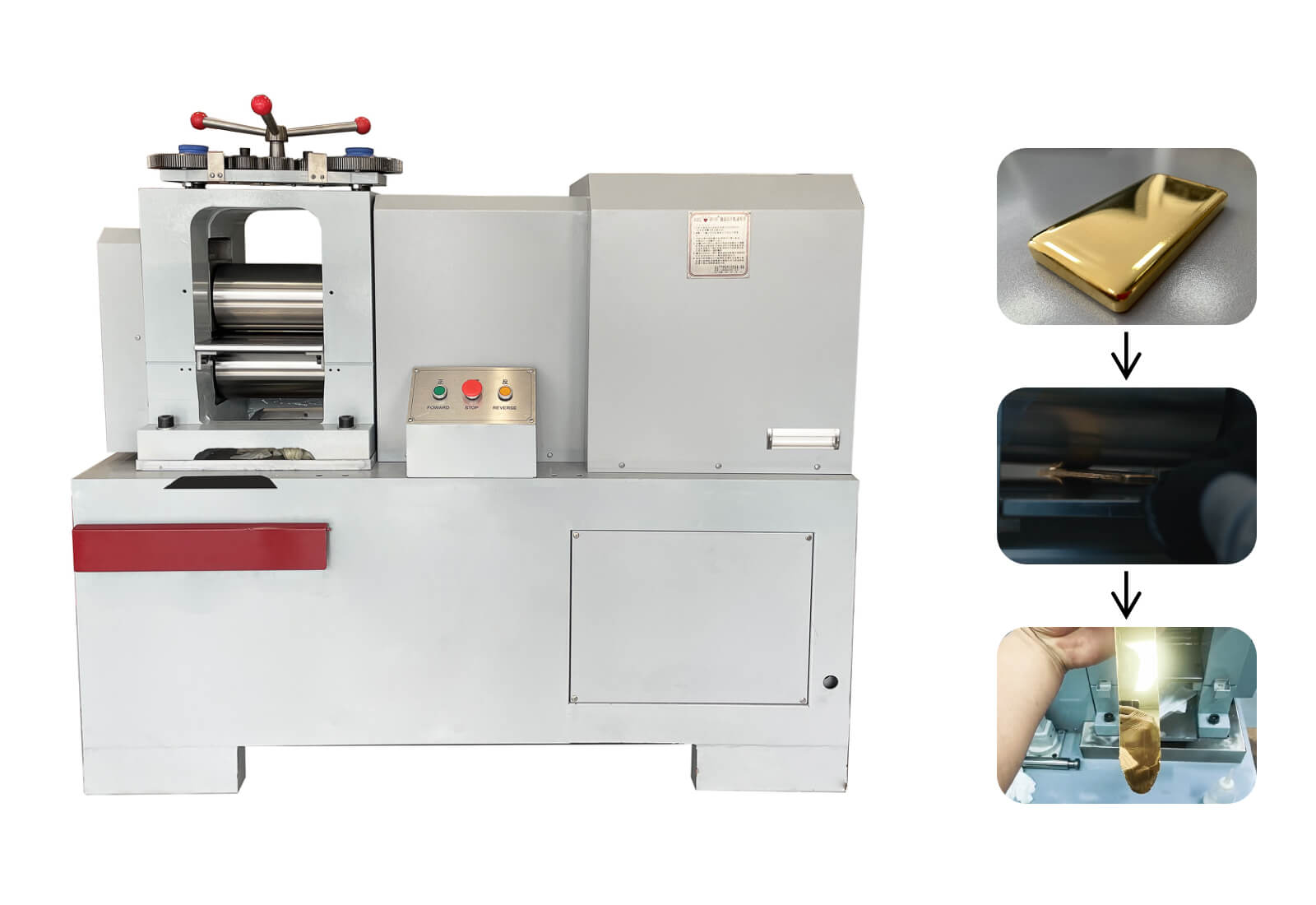
Material from the mold or continuous caster is commonly more than 10 mm thick. The first rolling mill performs the heavy reduction and brings this stock down to about 5 mm through several controlled passes. This is an easier and more stable job for a dedicated breakdown mill than trying to reduce directly toward thin sheet.
The goal is not final foil precision; it is to create flat, manageable 5 mm feed while monitoring edges, surface marks, straightness and material behavior. A rigid metal strip rolling mill is more suitable for this task than loading the delicate finishing mill with thick material.

Reduce 5 mm Strip to Uniform 0.1 mm Sheet
The middle rolling mill takes over at approximately 5 mm and progressively reduces the strip to about 0.1 mm. At this stage the operator prepares the width, flatness and surface condition required by the finishing mill. Consistent incoming gauge matters because sudden thick sections can disturb roll gap, strip tension and final foil stability.
Inspect both surfaces and trim damaged edges before the ultra-thin stage. Do not rely on the final mill to remove scratches, inclusions or deep roller marks.

Finish the Foil with the CNC Four-High Precision Rolling Mill
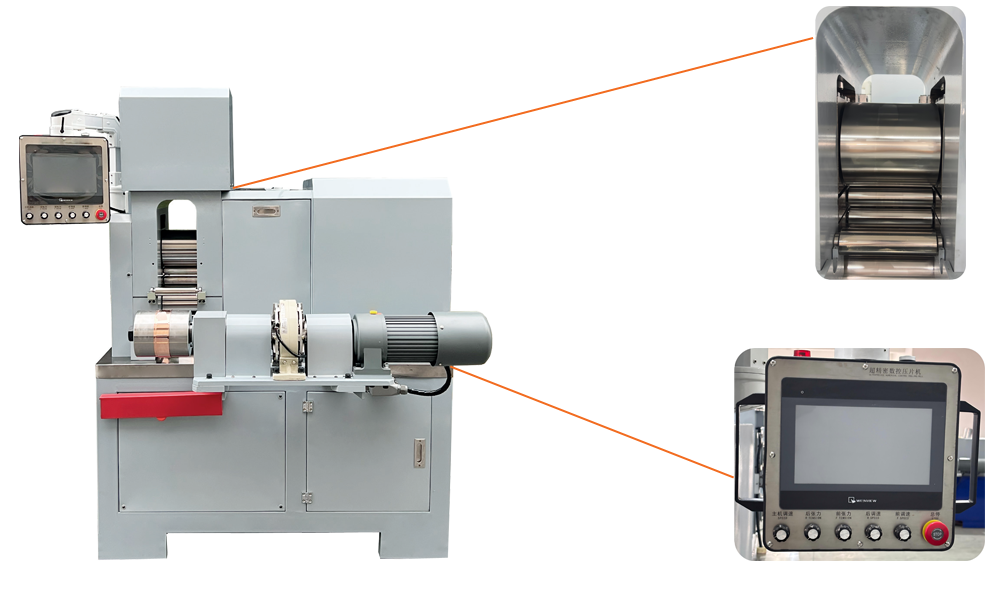
The 0.1 mm sheet enters the CNC four-high mill for progressive finishing passes toward approximately 0.005 mm. Smaller work rolls contact the foil while larger backup rolls support them and limit deflection. Twin servo downfeed controls the roll-gap adjustment, while payoff and take-up units manage the delicate strip during repeated passes.
The CDOCAST 15HP configuration is specified for 0.2–0.004 mm material and a maximum strip width of 150 mm. For gold banknote production, 0.005 mm is a practical normal target; 0.004 mm is the machine’s stated lower capability, not a guarantee for every alloy, width or pass schedule.
This is the key machine in the complete gold foil banknote making line. Its rolling system, servo adjustment, winding tension, operator setup and incoming strip quality collectively determine whether production succeeds.

Cut or Blank the Ultra-Thin Foil
Use a dedicated foil cutting machine or small press with a matched blanking tool to produce the required length and width. The tooling must support the foil without pulling, curling or producing rough edges. Keep the work surface clean and control static, airflow and handling because 0.005 mm foil moves easily.
Check both dimensions and weight. Cutting dimensions should be calculated from the target metal weight and average foil thickness, then adjusted using actual production results.

Use a Small Oven for Controlled Foil Cleaning
A small controlled-temperature oven can be used before embossing to remove light process residue or contamination according to the established cleaning method. This is a surface-preparation operation, not automatically a full annealing cycle.
For the proven Au 9999 and Ag 9999 ultra-thin process described here, a separate annealing furnace is normally unnecessary at the final foil stage. Alloyed gold or other materials may work-harden differently, so their rolling and heat-treatment route must be verified separately.

Emboss with a Hydraulic Press and Dedicated Gold Banknote Die
Place the clean foil in a purpose-built positioning die and use a controlled hydraulic minting press to form the artwork. The custom gold foil banknote die must be designed around foil thickness, note size, relief, single- or double-sided design and packaging method.
Pressure that is too low produces weak detail; excessive pressure, deep relief or poor alignment can tear, wrinkle or trap the foil. First-piece trials should establish press force, approach speed, dwell and release method.

Inspect and Package the Finished Gold Foil Banknote
Package the embossed foil promptly to protect it from fingerprints, dust, rubbing, bending and airflow. Capsule support is useful for some high-relief or display products; sealing or a blister card packaging machine may suit flatter branded products.
Mark the metal, purity, nominal weight and product identity clearly. Decorative bullion notes and souvenir products should be designed and marketed in compliance with applicable currency, hallmarking and consumer-protection rules.
Why the Production Line Needs Three Rolling Stages
| Rolling stage | Approximate thickness route | Main purpose | Why it should not be skipped |
|---|---|---|---|
| Breakdown rolling mill | Cast feed over 10 mm → about 5 mm | Performs the initial heavy reduction and prepares manageable flat strip. | Makes the large reduction easier and protects the following mills from very thick, uneven feed. |
| Intermediate rolling mill | About 5 mm → about 0.1 mm | Performs the main sheet reduction while improving gauge consistency and surface condition. | Provides stable 0.1 mm input for the ultra-thin finishing stage. |
| CNC four-high precision mill | About 0.1 mm → approximately 0.005 mm | Controls final foil gauge, flatness, strip handling and repeatability. | This stage determines whether the gold banknote foil can be produced reliably. |
No tungsten carbide rolling mill is required for this standard route. The process needs the correct three-machine thickness sequence. Roll material, surface and cleanliness still matter, but adding a tungsten-carbide mill is not necessary simply because the final foil is very thin.
What Makes the CNC Four-Roller Rolling Mill Different?
At ultra-thin gauge, a basic two-high mill becomes increasingly sensitive to roll deflection, roll-gap adjustment and strip handling. A four-high arrangement supports smaller work rolls with larger backup rolls, helping maintain a more useful working geometry across the strip.
- Servo downfeed: repeatable roll-gap adjustment for the finishing sequence.
- CNC operation: structured pass settings and easier repeat production.
- Backup rolls: support the smaller work rolls during thin-gauge reduction.
- Payoff and take-up: manage long, fragile foil with controlled winding tension.
- Variable speed: allows the operator to match rolling behavior to the material and pass.
- Automatic lubrication: supports the rolling mechanism during repeated production.
Machine specification alone is not enough. Incoming thickness, foil width, roll cleanliness, pass reduction, winding tension and operator experience remain decisive.
Why the US $100 Banknote Format Is Common for 1 g Gold Foil
For process planning, the theoretical metal weight can be estimated from foil area, average thickness and density:
Weight = Length × Width × Average Thickness × Metal DensityA format near 156 × 66 mm rolled to an average 0.005 mm thickness has a theoretical pure-gold weight close to 1 g when calculated with gold density near 19.32 g/cm³. This is one practical reason that the approximate US $100 banknote format is common for thin 1 g gold-note products.
This is a planning calculation, not the final certificate value. Real production must account for cutting tolerance, embossed geometry, local thickness variation and actual weighing.
Why Au 9999 and Ag 9999 Are Easier Than Many Alloys
High-purity gold and silver are generally more workable for this ultra-thin route than many harder alloy compositions. Alloys can increase work hardening, edge cracking, springback and sensitivity to the reduction schedule. That does not mean every pure-metal run is automatic: casting quality, roll condition and operator control still matter.
High ductility supports progressive ultra-thin rolling and delicate embossing. Strict cleanliness and precious-metal recovery remain essential.
Suitable for silver foil commemorative notes, with attention to surface oxidation, handling marks and its different density-to-weight relationship.
Require material-specific trials for work hardening, annealing need, reduction per pass and embossing pressure. Do not copy the pure-metal settings automatically.
How to Check 0.005 mm Gold Foil During Production
Many Chinese production workshops use manual sampling during setup and production. The method must suit delicate foil and have adequate resolution. A conventional micrometer can compress or damage very thin material if used incorrectly.
The selected online gauge must be compatible with precious-metal foil, the thickness range, strip width, line speed and installation environment. It is an optional quality upgrade, not a replacement for correct rolling setup.
Can Gold Foil Banknotes Be Larger Than the US $100 Size?
Yes. The product is not restricted to one banknote proportion. The design must remain within the configured rolling width, cutting tool, die size, press working area and packaging format. The CDOCAST 15HP four-high mill has a stated maximum strip width of 150 mm, so the note orientation and production layout must be planned accordingly.
Larger ultra-thin foils are harder to guide, keep flat, clean, position and emboss without folds. The machine can support different formats within its working envelope, but larger products demand stronger operator technique and better handling fixtures.
Two Practical Gold Foil Banknote Production Line Options
Common Gold Foil Defects and What to Check
| Problem | Possible causes | Checks |
|---|---|---|
| Foil cannot reach target thickness | Incorrect incoming gauge, insufficient finishing configuration, unsuitable pass schedule or strip tension. | Verify 0.1 mm input, servo gap setting, roll condition, reduction sequence and winding system. |
| Wrinkles or uneven winding | Misalignment, unstable tension, asymmetric incoming strip or excessive pass reduction. | Check payoff/take-up alignment, magnetic clutch setting, edge condition and strip flatness. |
| Thickness differs across width | Roll deflection, roll-gap parallelism, uneven starting strip or contaminated roll surface. | Measure left-center-right, inspect work and backup rolls, and verify servo synchronization. |
| Foil tears during rolling | Edge cracks, inclusions, work hardening, local thick spots, surface defects or excessive tension. | Trace the defect back to casting and intermediate rolling; reduce the final pass severity. |
| Foil tears during embossing | Relief too deep, pressure too high, poor die alignment, trapped dirt or unsupported foil. | Review die relief, pressure recipe, positioning holder and foil cleanliness. |
| Surface is dull or scratched | Dirty rolls, handling contact, residue, scratched die or delayed packaging. | Clean the complete contact route and inspect under consistent lighting before packing. |
Machines Used in the Gold Foil Banknote Line
Gold Foil Banknote Production FAQ
What is the minimum thickness of the CNC four-high rolling mill?
The specified CDOCAST 15HP CNC four-high mill covers 0.2–0.004 mm with a maximum rolling width of 150 mm. Gold foil banknote production commonly targets about 0.005 mm. Achieving the lowest gauge depends on material, incoming thickness, width, pass schedule, roll condition and operator setup.
Which machine is most important in a gold foil banknote line?
The CNC servo-controlled four-high precision rolling mill is the key machine. It performs the final reduction from about 0.1 mm to approximately 0.005 mm and controls the foil condition entering cutting and embossing.
Do I need a tungsten carbide rolling mill?
No, not for the standard process described here. The line normally uses three rolling stages: breakdown rolling from cast stock over 10 mm to about 5 mm, intermediate rolling from about 5 mm to 0.1 mm, and final CNC four-high rolling to the required foil thickness.
Does ultra-thin gold foil need an annealing furnace?
For the established Au 9999 or Ag 9999 process, a separate annealing furnace is normally unnecessary in the final ultra-thin stage. A small oven may be used for controlled cleaning. Alloys work-harden differently and may require a separate material-specific heat-treatment plan.
Can customers see the complete production process?
Yes. CDOCAST can share the available production video, arrange a video discussion around a customer production process, or discuss a visit to China to review suitable equipment and production examples, subject to customer-site permission and scheduling.
What size can a gold foil banknote be?
The approximate US $100 format is common, especially for a thin product near 1 g, but larger or custom formats are possible within the rolling width, cutting tool, die, press and packaging limits. Larger foils require more skilled handling and process control.
How is 0.005 mm foil thickness measured?
Many workshops use manual multi-point sampling with a suitable low-force foil gauge and cross-check average thickness using known area, weight and density. Customers with a higher automation budget can add a compatible online thickness gauge.
Can one machine complete the whole production line?
No. The full route requires material preparation, three rolling stages, cutting, surface preparation, hydraulic embossing with dedicated tooling and protective packaging. CDOCAST can match these machines as a complete process solution.
Plan the Line Around Your Foil Size, Weight and Material
Send CDOCAST the metal purity, target banknote dimensions, nominal weight, daily output, artwork, relief, packaging method and available power. We can compare melting with continuous casting, select the three rolling stages, evaluate the 0.005 mm process and match the cutting, cleaning, hydraulic pressing and packaging equipment.
Discuss Your Gold Foil Banknote Project